
Every coding agent, no wrapper required.
Private telemetry for AI coding teams
AI coding work, indexed.
Jin captures local agent sessions, turns scattered transcripts into a shared schema, and routes the signal your team needs into infrastructure you control.
Sessions, tools, tokens, branches, and cost in one schema.
Local by default, synced to Postgres, S3, R2, or webhooks.
$ curl -fsSL https://jin.builtbyeden.app/install.sh | sh
For:
Developers, Team Leads, Engineering Leaders, Platform & DevEx.
One private index across AI coding work, with the right view for the people building, managing, funding, and rolling it out.
Find the session behind the commit.
Search prompts, tool calls, branches, and agent output when the useful context is buried in a tool-specific transcript.
- Local session recall
- Reviewable agent traces
- Faster debugging after AI-assisted changes
Spot where AI work is helping or looping.
Understand which projects, tools, and repeated workflows are moving faster without reading every transcript or chasing status.
- Team adoption patterns
- Repeated blocker visibility
- Useful context for coaching
Turn AI coding usage into operating signal.
Track adoption, spend, model mix, and delivery patterns across teams while keeping the data in your infrastructure.
- Spend and usage trends
- Project-level momentum
- Private analytics in your stack
Standardize telemetry without tool lock-in.
Give platform and developer experience teams one passive daemon, one schema, and clean adoption data across every coding agent developers already use.
- Adoption by tool and model
- Policy gaps before incidents
- No wrapper around developer workflow
The jin bundle
One product, three surfaces.
Lead with the passive daemon. No hooks, no workflow wrapper, and no interrupted coding sessions just to collect telemetry.
jin JustIndex
The passive daemon
Captures local AI coding sessions across Claude Code, Cursor, Codex, Warp, Gemini CLI, and more, then normalizes them into one local data model.
- Read-only adapters
- Local SQLite store
- Tool calls, tokens, cost, branches
jin desktop JustInfo
The developer surface
Gives engineers a fast local interface for session recall, routing status, project history, and the context behind agent-generated changes.
- Session search
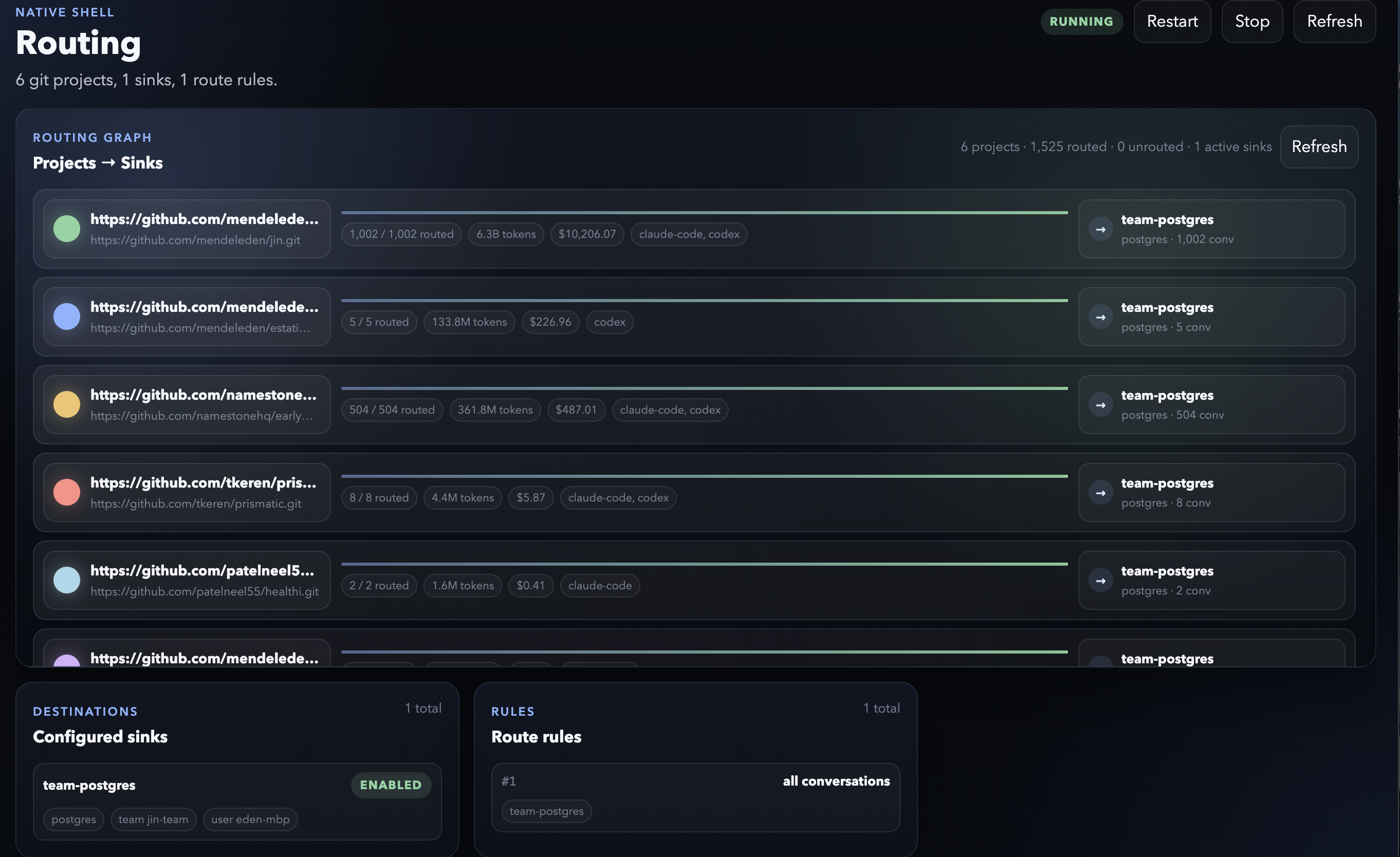
- Project routing
- Desktop control plane
jin team JustInsight
The organization view
Routes normalized sessions into your Postgres, S3, R2, or webhook infrastructure so leaders can understand adoption, spend, and delivery patterns.
- Team onboarding codes
- Private sinks
- Usage and workflow analytics
How it works
A private system of record for agentic work.
01 Capture
02 Normalize
03 Inspect
04 Route
05 Understand
$ jin stats --since=7d
claude-code  421 sessions  38.2M tokens  $312.40
cursor       106 sessions   9.7M tokens   $71.12
codex         64 sessions   6.1M tokens   $44.90

$ jin team-config --type=postgres --team-id=platform
ready: one command for every developer
Trust model
Developer-native by default. Enterprise-ready by architecture.
No hooks
Jin reads native tool data passively. It never inserts hooks into coding sessions or interrupts developers for telemetry.
Local first
The daemon normalizes to a local store before anything is routed to a team destination.
Your infrastructure
Send data to Postgres, S3, R2, or webhooks without adopting another hosted black box.
One schema
Compare tools, models, projects, token usage, and tool calls without hand-parsing logs.
Start with the daemon